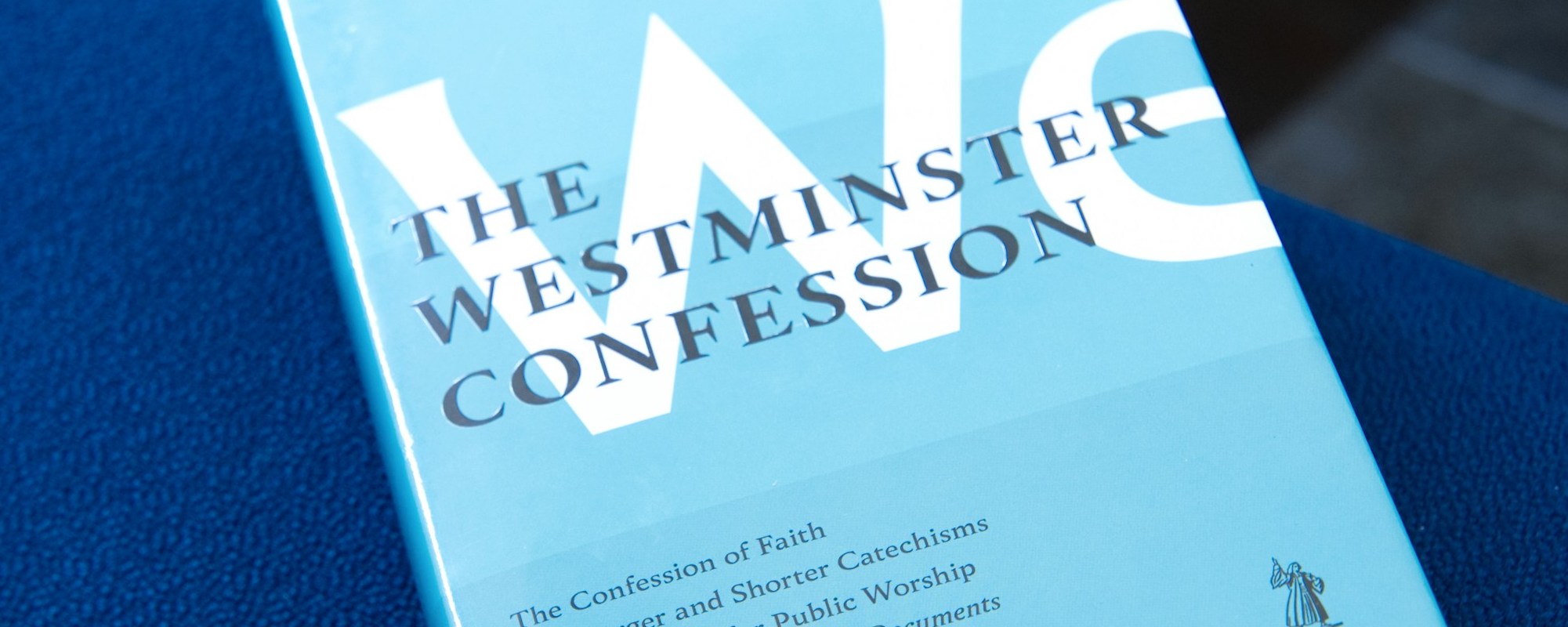
Why is it important for us to familiarize ourselves with the Westminster Confession? Pastor Jason Fest speaks.
Listen above or download the audio file here.
Transcript:
Well, this is second week of our series, kind of a summer series on the Westminster Confession of Faith. I’d remind you again, if you don’t already have a copy, they’re available online for like dirt cheap in a variety of formats. Yes, Kathy, you can get a PDF of it for free and different versions, yes.
There’s large print versions and small print versions. There’s hardback and soft and little portable ones like I have here, which I really love. There’s excellent commentaries too, if you’re taking notes, I would recommend to you two.
The first one, My Favors by G.I. Williamson, his commentary on the Westminster Confession of Faith, G.I. Williamson. And then the other one that’s very well known is from R.C. Sproul, beloved R.C. Sproul, which is called, Kathy, help me out, something, Truths That We Confess, also very good as well. Now, just some review from last week.
So bear with me, we’re not gonna get into it, the confession itself this week either. There’s a lot of things I really think are very important. Again, as I said last week, to set the stage, to sort of create the framework for us to enter into this confession.
Introductory remarks and initial thoughts, I think are just really, really important to establish the why. Why? Why is it good for us to grow familiar with this confession? Now, last week, I began by stating clearly that we are a confessional church. Our doctrinal standard, our doctrinal statement, the doctrinal statement of Trinity Reformed Church is the Westminster Confession of Faith.
And it’s on our website. I talked about from Votibachum, how we live in a post-confessional age, the difference between post-confessional and anti-confessional. Anti-confessional is where you have a lot of churches, it’s a culture, an environment where the confessions, like the Westminster, are at least acknowledged in the contents of the confession.
It’s just that there’s disagreement about what is stated in here. Or there’s disagreement whether or not the church, whether or not Christians should even have a confession like this, whether this is even important. Then there’s post-confessional, which to an extent, I believe we live in a time of post-confessional, this is Voti’s point, where Christians by and large in the church, they don’t even know what a confession is.
It’s been gone for so long, ignored, that a lot of Christians don’t even know what it is. So I think that’s important. And then within that context, then again, stating that we, well, we are, we are a confessional church intentionally.
A lot of churches have a statement of faith somewhere on their website that just kind of stays there in the closet, so to speak. Our confession of faith is also on our website, but we’re very much intentionally, we try to, in our teaching and preaching, bring it to the forefront. These are our beliefs about God.
We believe that this confession, we believe that the Westminster, generally speaking, is a accurate, a good summary of biblical truths. It’s a good summary of what the Bible teaches us, all 66 books, taking into account the whole counsel of God. Last week, I also mentioned that because of the fact we live in a post-confessional age, there is a tendency for us, as we’ve come to know and become familiar with these things, that we still easily forget that they’re there.
They’re great tools, not just the confession, but the catechisms. And again, a catechism is just a confession written in a question and answer format for easy teaching, but the confessions and catechisms are great, great tools for sharing the gospel with somebody. It provides you a good, deep, solid roadmap to lead someone through the gospel.
Take, for example, the Heidelberg Catechism. What a great opening question. What’s your only comfort in life and death? What a great question.
So they’re great for that, also great for friends, family, who are Christians, who need discipleship. They provide a great roadmap for discipleship for anybody to deepen their faith. One of the problems that Francis Schaeffer had a great quote, he said, a lot of Christians have bits and pieces, they have shards of the story, but many, many Christians lack a cohesion of the whole tapestry, weaving it all together from beginning to end.
Well, the confessions and the catechisms provide that. They fill in the gaps and bring it all together. So for discipleship, for deepening your faith, either again, if you’re leading someone in discipleship, they’re a great tool, but of course, first and foremost, we want you to be familiar with these things so that you can deepen in your understanding of the gospel and of the whole counsel of God, essentially of what reality is, because that’s really what we’re talking about.
What is reality? Reality, first of all, is that Jesus Christ is Lord. That’s reality, regardless of how anyone feels about it or whether they believe in it or not, that’s reality. So understanding and having a complete picture of the whole, the totality, the comprehensiveness of what reality is from a distinctly biblical worldview.
We don’t need to reinvent the wheel. That hard work, the fruit of the labors of those who’ve come before us, they’ve done it. We have it.
And remember the words of Christ, to whom much is given, much is required. So we are the recipients of this wonderful heritage, and we want at the very least to be familiar with these things and so that’s gonna take some intentionality because we’re not used to them yet. I know I’m not still, so we wanna change that.
Hopefully that’ll be changed as a result of this series. Something else I wanna say then moving ahead, very important point. This is no mere knowledge.
I want us to all understand that this is no mere knowledge. 1 Corinthians chapter eight, Paul says, all of us possess knowledge. This quote unquote knowledge puffs up, but love builds up.
1 Corinthians eight, that’s 1 Corinthians eight, verse one, verse two, he says, if anyone imagines that he knows something, if anyone imagines that he knows something, he does not yet know as he ought to know. What’s he talking about there? If you’re just accumulating information and the fruit of that is you’re just getting puffed up and conceited and think you know everything and you know more than everybody else, okay, you don’t know the way you think you know. You’re not really knowing.
How do you tell if you’re really not only accumulating this information, but it’s going into your heart and transforming you? How do you know that? Well, the fruit of that will be love and that’s expressed love wants to bring others and build others up with what you’re learning. There’s a desire there to share these glorious truths and they are glorious truths. So that’s not being conceited, that’s not being puffed up.
So we wanna remember that too. We’re not studying these things so that we can be puffed up know-it-alls. That is not the goal.
We’re studying these things so that we can know more about the God we love and worship and have a deeper love and gratitude to him for who he is and what he has accomplished for us in Jesus Christ. We heard in Nate’s sermon before he left on sabbatical and John 8, perfect example of the Pharisees. The Pharisees had the right facts about God, at least to the extent that they could distinguish Yahweh from all the other pagan gods, Baal and all the other ones are escaping my mind right now, but they can make that distinction.
And yet they hated him. Here’s the son of God right before them and they hated him. So from this, we learn that we can have the right facts about God, but that does not equal a right relationship with God.
So this is something to bear in mind too, as we set off to learn what the confession teaches us here. You can have right facts about God. You can have your doctrine in line and accurate, but that does not in and of itself equal a loving, saving relationship with God.
And again, I would add the fruit. If you do have that, the fruit will be love, a love and a desire to build up your brothers and sisters with what you’re learning. Now, yet, don’t be deceived either because you cannot have a relationship with God without knowing the facts about God, who he is, who he has revealed himself to be in Christ.
You do need that accurate information too. So we can say we need two things to have saving faith in Jesus Christ and in God. You need two things.
You need, first of all, God’s revelation of himself to us, which is found in his word. You have to have that. And that is accurate information about who he is.
You do have to have that. But the second essential thing that you have to have, which we do not have by nature, is the capacity to be able to receive and believe that accurate information. So two things required.
And the first is, yes, yes, accurate information about who God is from his word, what we would call divine revelation, God’s revelation of himself to us, but also you need the capacity to receive it. And for that, you need to be born again. For that, you need to be born again.
That is not present in us by nature. Okay, so there’s that. Also, remember, I pointed this out the first go around, that what our confessions and creeds and catechisms are answering over and over again is not only what do you believe? That’s what a creed is.
A creed is just, it just means it’s credo, what you believe. They’re answering the question, what do you believe? But also, okay, what do you mean by that? Okay, you say you believe in God. Great, what do you mean by that? You believe in Jesus, wonderful.
What do you mean by that? That’s what the creeds and confessions and catechisms are answering and helping us to answer, helping us to answer fully and deeply. Again, taking into account the whole counsel of God, not just select verses that give us comfort that we rip out of the pages of the Bible and hold up in form of theology out of. We wanna be able to answer that question, what do you believe and what do you mean by that, taking into account the whole counsel of God, what he has revealed about himself in all 66 books of the Bible.
Because when it comes to what we believe about the Bible and what it teaches us about God, don’t forget, and the Westminster Shorter Catechism points this out, there’s what you believe about God, but there’s also what duty God requires of us. And we get that from scripture. So it’s not just what you believe, but what duty does he require of us? And so basically what we’re saying as a church is that when it comes to those things, the Westminster Standards, okay, it’s called the Westminster Standards, that encompasses and includes the Westminster Confession of Faith, the Westminster Larger Catechism and the Westminster Shorter Catechism, as well as some other documents, we’re saying that we believe that they are a faithful summary of the Bible’s teaching or doctrines.
Very important. We are not saying that they are equal in authority. They’re not equal in authority, but they are a determined attempt to remain faithful to the Bible and to explain briefly what the 66 books of the Bible teach.
Is that clear to everybody? Any questions so far on that? So some very important distinctions we wanna make and maintain and hold as we go through this series. Very important, but not equal in authority to scripture, but just a faithful summary of scripture. So again, we have not been trained, many of us to think this way.
And so it takes some intentionality to retrain our minds in these kinds of categories. You know, I had some thoughts on, I was thinking about United States citizenship and churchmanship. As US citizens, I believe to a large extent, we have squandered our freedoms and liberties.
I think we saw a lot of the fruit of this during the whole COVID debacle. I think we, by and large as Americans, have grown lazy and apathetic, complacent and disinterested. And this is the fruit, I believe, of our decadence.
And I, as I was reflecting on this, was realizing my part in this, the part that I’ve played. So on the one hand, you have blood being spilled and countless lives given to us so that we can have these constitutional freedoms and liberties that we have taken for granted. And I myself, I have to admit, have taken them for granted and have had no interest in studying and learning and knowing what my constitutional rights are in order to protect and maintain them, not only for myself, but for my family and for my neighbor.
I remember thinking about this with all the COVID stuff as seemingly our rights were being taken away. Now, wait a second, I haven’t been keeping up with what my rights are. With liberty and freedom comes responsibility.
That’s the key. Being subject to totalitarianism or a tyrant does not require responsibility. To be a slave does not require that.
But to maintain, to have, to possess liberties and to maintain those liberties and freedoms does require responsibility. To have certain rights, you gotta know what those rights are, how to exercise them rightly. And I know for most of my life, it’s just something I’ve taken for granted.
I can remember still in high school having a civics class, but I don’t think, I’m curious, I don’t hear about that much anymore in public schools, even. Of course, we’re all homeschooled, but. Pretty sure it’s still required to have a- You think so? Yes.
Really? In the end, I think you’d still have to take a government class to graduate. Okay, that’s good. That’s surprising.
And is it state? I wonder if it’s state by state. I would be curious, like- It’s state by state. Right.
So I wonder how many states that’s still a requirement for. Yes, Dave. Well, what you said is accurate in terms of the rights and the constitution.
However, like you said, we have not, we are not in a position as adults and older people outside of the government classes and schools, we are not in a position to have anybody do so too. We don’t have a group available where you can sit down and talk about it, come to a conclusion and pass that along to the government leaders that we are under their control. That type of organization, to my knowledge, doesn’t exist.
Yeah, I mean, in terms of learning about those things? Yes. Yeah, well, what actually spurned these thoughts was I was taking a Hillsdale course, which is free online. So there’s one good resource.
Hillsdale College in Michigan has a number of free online education courses, one of which, this particular, was not on citizenship. I’m doing that one now. This was on the constitution.
I think it was called Constitution 101 or something. You’re familiar with it? Very, I mean, excellent, excellent course. So that’s where it got me thinking like, okay, until then, which is relatively recently, I’ve really not taken an interest.
I just have to admit, I wasn’t very familiar with even the contents of the constitution itself, the amendments, the Declaration of Independence. I mean, I was familiar with these things. I knew what they were, but I couldn’t tell you much about them.
So I’ve had some repenting to do in that department. Yeah, Kathy? Yeah. Yeah.
Cool, yeah, I would like to visit. So if you’re like me, if that’s something we have to own and seek to change. Now, so when it comes to churchmanship, being faithful members of a church, I think there’s a good comparison there.
We don’t want to fall into the same trap. And so we can think of these as founding documents, really. Again, this is a heritage we’re receiving, again, making the important qualification.
This is not scripture, but there is an accurate summary, taking all of scripture together of our faith and the teaching of the church. So we don’t want to fall into that trap as churchmen either. We want to be knowledgeable Christians about what we believe and have the ability to share our faith with others, but also be able to know and understand it ourself when it comes to especially summarizing the truth, being able to summarize the truth.
A couple of quotes I want to share this morning. One’s from Carl Truman. It’s from his book, The Rise and Triumph of the Modern Self.
Excellent book. He says in there, most of us don’t think about the world in the way that we do because we’ve reasoned from first principles to a comprehensive understanding of the cosmos. Most of us have not done that, he says.
And I think he’s right. Rather, we generally operate on the basis of intuitions that we’ve just unconsciously absorbed from the culture around us. I think there’s truth in that.
For a majority of folks, and the question I’m going to ask is, do you want this to be true of you? I know I don’t want it to be true of me, but for most folks, they’re operating and their view of the world, they’re operating on just stuff they’ve absorbed, whatever that is, good or bad. Most people don’t really examine their beliefs. He says, most of us don’t self-consciously reflect on life and the world as we live in it for various reasons.
But I think he’s right. Again, instead, he says, we think and act intuitively in accordance with the way we instinctively imagine the world to be. So again, I ask you saints, do you want that to be true of you? I’m not asking if it’s true.
You search your own heart. I’m asking, do you want that to be true of you? I know I don’t, but I want to operate that way. And we certainly, as parents, don’t want to instill that to our children to operate that way, to just operate with a view of life and the world, and even who God is from just simply things they absorb.
We want to study these things and be intentional about it. He goes on to say, the few people among the general public today have firsthand knowledge or familiarity with the writings and thought of Nietzsche, Karl Marx, Sigmund Freud, or Darwin, but many of the key ideas of these men profoundly shaped the way that the average man or woman on the street imagines the world to be. Now that’s something we need to take heed of, and I believe he’s exactly right there.
You may have never heard of them. You may not care who they are, be very knowledgeable of these men, but make no mistake, their ideas, their godless philosophies permeate our society, permeate the air that we breathe. So this is something we want to be aware of and push back against, taking every thought captive to Christ, bringing all of our thoughts, the way we think, not just what we think about, but even the way we think, we want all of that to be in conformity with God’s word and his revelation of who he is.
A fellow named Herman Bavink, he wrote Reformed Dogmatics, a systematic theology. I think he was a late 19th century theologian, Dutch theologian. He was a contemporary of sphere sovereignty.
Kuyper, Abraham Kuyper. He says this, now listen to this. This is very sobering.
Look, the general rule is that people die in the religion in which they were born. That is the general rule. It goes right along with what I just read from Truman.
The general rule, people die in the religion in which they were born. As a rule, Muslims, Christians, Roman Catholics or Protestant remain faithful to the religion of their youth and parents until they die. Now, the parents go to a faithful church have genuine faith, are committed to in faith in Christ, raising up their children in the fear and admonition of the Lord and all those things.
This is good news because that means generally speaking, these things do get passed down. But where that’s lacking, generally speaking, in the general population, whatever’s being taught and conveyed, that’s gonna remain unchanged. He says, except for times of religious crisis, such as the rise of Christianity or Islam or the Reformation, conversions are rare.
A change of religion is the exception, not the rule. Most people, most people even live and die without ever being shaken in their religious beliefs by serious doubt. This is a pretty big statement he’s making here.
Most people live and die without ever being shaken in their religious beliefs by serious doubt. The question of why they believe in the truth of the religious ideas in which they were brought up does not occur to them. They believe, they find more or less satisfaction in their faith, and they do not think about the grounds on which their conviction is based.
Generally speaking. Again, do we want that to be true of us? Is that what we want? No, it’s not. So don’t let it be.
So it starts with paying attention. Paying attention to God’s word, paying attention when you’re at church and considering these things. Last quote, this is from Herbert Schlossberg, very well-known book, I would recommend.
Another one of my favorite books, Idols for Destruction, where he catalogs the idols of American religion. Very good book. This kind of goes along with what Truman said earlier.
He says, anti-philosophers are especially vulnerable. So this would be folks who don’t care about philosophy. They don’t care those people we mentioned, they don’t care about all of that.
They’re anti-philosophers. Well, he’s saying they’re especially vulnerable because the media fill our environment with popularized philosophies. Environments tend not to be noticed, he says.
Environments tend to not be noticed. We see much of their explicit content, but the environment themselves are imperceptible. We don’t see the environment as Oz Guinness says, because we see with it.
It becomes the lens through which we see things. We’re influenced by ideas we don’t notice and therefore are not aware of their effect on us. We’re influenced by ideas we do not notice and therefore we are not aware of its effect on us.
So take that to heart, be aware of that. So that’s why we wanna fill our head with the truth. We wanna fill our heads with the truth and push out all of those things.
And by filling our heads with the truth from God’s revelation of himself, counteract these philosophies that we’ve been, many of us have just been swimming in and taken for granted for most of our lives. That’s gonna take intentionality. You can’t just say, well, okay, I don’t wanna believe that anymore.
Can you get to replace it with something? And as deep and pervasive as these godless philosophies have worked into the dough, so to speak, of our society, it’s gonna take a lot to work into the dough. For that, slogans and Christian platitudes are not gonna cut it. You need a robust, rigorous, full-orbed, comprehensive face, which coincidentally the Christian faith is.
That is what the Bible gives us. We just need to believe all of it. We just need to present and understand and be familiar with all of it and be taught and preached to from all of it.
It is the counter, but you gotta take the whole thing and not be selective with it. Any questions so far on that? I see gears turning. I smell burning, so I think you guys are thinking about this stuff.
All right, let me make two more points here. I’ve been waiting to do this. I wanna give you guys some alternative creeds and confessions.
You know, we’ve said this before. Look, having a confession, having a creed, catechism, it’s inescapable. Everyone’s got them.
Everyone does. It’s just a matter of what it is. And some are public, some are written down, some can be evaluated and judged because they’re there.
Others are privately held, but everybody’s got a creed. Again, a creed is just what I believe. And a confession is just a longer creed.
It’s just more developed. And again, to repeat, a catechism is just a creed or confession written in a question and answer format. So let me give you a perfect example of that.
This was written and recited in 1969 by a woman named Kate Millett. I don’t know if that sounds familiar to anybody. She was, I believe, one of the founders of NOW, the National Organization for Women.
They’re very instrumental in the pro-abortion movement and women’s rights. And this would have been the first, I believe the beginnings of second wave feminism. So this is Kate Millett.
They’re having a gathering at someone’s house at the home of one of their friends. They call this a consciousness raising group. And it’s a typical communist exercise.
So here they all, they’re meeting at this house and they’re all gathered around the table. And here they begin this back and forth resuscitation. The question is asked, and let’s think about what we do in church upstairs.
So the question is asked, why are we here today? The answer given, to make revolution. What kind of revolution? The cultural revolution. And how do we make cultural revolution? By destroying the American family.
How do we destroy the family? By destroying the American patriarch. How do we destroy the American patriarch? By taking away his power. How do we take away his power? By destroying monogamy.
How can we destroy monogamy? By promoting promiscuity, eroticism, prostitution, and homosexuality. So there’s an example of an alternative creed or confession or catechism really, is what we have there. And these things are potent.
So you can imagine this group getting together week after week and reciting these things. This is how it’s taught. This is how it’s spread out.
Here’s another one in the form, in a different form, but it’s basically a creed or confession. You know, we say upstairs, Christian, what do you believe? And then Christians recite back. Well, we could say here, famous rock stars from the 1980s.
What do you believe? We believe there comes a time when we heed a certain call, when the world must come together as one. There are people dying. It’s time to lend a hand to life, the greatest gift of all.
Does this sound familiar to anybody? We can’t go on pretending day by day that someone somewhere will soon make a change. We are all a part of God’s great big family. And the truth, you know, love is all we need.
We are the world. We are the children. We’re the ones who make a brighter day.
So let’s start giving. There’s a choice we’re making. We’re saving our own lives.
It’s true, we’ll make a better day, just you and me. That was, of course, that was hugely popular. I mean, that song was everywhere.
Yeah, yeah, yeah, that was the 80s. Yep. What’s that? So communism, yeah.
Yeah, but for that 25%, there you go. That’s a little present for you. That’s the best song I ever heard.
Yes, there you go. Okay, well, that’s stuck in there. Yeah, so you got a picture, like the biggest stars of the 1980s in music.
I mean, Bob Dylan, Bruce Springsteen, Cindy Lauper. Michael Jackson, of course, was at the top of his game. And he was really the facilitator to bring all of these top musicians together and sing this.
What’s that? There you go. I did not know Tina Turner was a Buddhist. Yeah.
Well, yeah, thank you, because that’s a good point. Now, obviously, when I was a younger man, I just saw it as a song, but I see it differently now. You know, here’s an example of how creeds and confessions can take the form of a popular song.
You add music to it and familiar voices, and then you push that out. Now you’ve got something really potent. Now you have something that really can shape people.
And again, I keep saying this, and how they think. You’re instilling values through a creed set to music and performed by specialists in their field. Yes, Kathy, then Ben.
Let’s do Ben first, because I forgot what those guys are. Okay, Ben, then Kathy. We need to be kind and help one another, and that’s all the world is saying.
Right, and it depends on us. There is no God above. Well, there’s a reference to, we’re all part of God’s family, which is just pulled out of the air, but yeah, right, social gospel, right.
I mean, they talk about God, but then it’s all about me. Yeah. So it’s that creative and creative intention where, okay, they put God in there so it makes it sound good.
Yeah. But then on the flip side of that, it’s all about me making the change, and me doing it. Okay, so right.
So thank you. That’s a good segue, because I would call it humanism. It’s straight up humanism.
And I have here a copy of the Humanist Manifesto. So here is another example. This is the Humanist Manifesto I. I think I told you there was three.
I think there’s only two, two versions. The first version was written in 1933. So you’re talking the beginning of the 20th century, 1933.
We’ve gone through a world war, but we have not yet gone through a second world war. And so here you have the Humanist Manifesto. I’m obviously not gonna read the whole thing, but I wanna read some excerpts from it.
Here’s the very first opening paragraph to the Humanist Manifesto. The manifesto is a product of many minds. It was designed to represent a developing point of view, not a new creed.
They wanna make sure you understand that. This is not a new creed. I’m guessing they’re saying that because of the religious connotations, which they are and will outline they are thoroughly against.
The individuals whose signatures appear would, had they been writing individual statements, have stated the propositions in differing terms. The importance of the document is that more than 30 men have come to general agreement on matters of final concern, and that these men are undoubtedly representative of a large number who are forging a new philosophy out of the materials of the modern world. And that’s something that goes all throughout this document.
They’re very big on the modern world, and now we need modern solutions. And the thing they wanna make clear is old religion and dogmatism and all of that stuff does not apply anymore, and we have got to deliver ourselves from that old system and those old ways. The time has come for widespread recognition of the radical changes in religious beliefs throughout the modern world.
Time has passed for mere revision of traditional attitudes. Science and economic change have disrupted the old beliefs. Religions the world over are under the necessity of coming to terms with new condition created by a vastly increased knowledge and experience.
Now, of course, what would we say? We’d say, no, the gospel still remains relevant because man has not changed at all. He’s still a sinner at heart. He is still a rebel at heart.
The problem’s the same. Therefore, the solution remains the same. But not according to them.
According to them, we’ve discovered new information. We have increased knowledge now, so we need new and better ways to find prosperity. Now, there’s one, two, three, four.
There’s 15 sort of affirmations they make. I won’t go through all of those. But at the end, they say, so stand these theses of religious humanism.
Though we consider the religious forms and ideas of our fathers no longer adequate, the quest for the good life is still the central task for mankind. So there’s a statement. According to the manifesto, the humanist manifesto, what is the chief end of man? It is to find the good life.
Man is at last becoming aware that he alone is responsible for the realization of the world of his dreams. Now, what I find really, really fascinating is 1973, now, you have the releasing of the manifesto, humanist manifesto two. Now, bear in mind, we’ve had some wars since the first one.
So let’s see if anything changes. First words in the preface. Humanist manifesto two, 1973.
First one was 33, now we’re 1973. That’s when I was born. It’s 40 years since humanist manifesto one appeared.
Events since then make that earlier statement seem far too optimistic. Oh, okay. I think that’s as close as they come to admitting they were just flat out wrong.
Nazism has shown the depth of brutality of which humanity is capable. Other totalitarian regimes have suppressed human rights without ending poverty. Science has sometimes brought evil as well as good.
Recent decades have shown that inhuman wars can be made in the name of peace. Now, skipping down, they say that as in 1933, humanists still believe that traditional theism, especially faith in the prayer hearing God, assumed to live and care for persons, to hear and understand their prayers and to be able to do something about them is an unproved and outmoded faith. Salvationism, what they’re calling it, based on mere affirmation still appears as harmful, diverting people with false hopes of heaven hereafter.
Reasonable minds look to other means for survival. So, there you go. There’s another confession.
We’re about to take a look at what we believe is a faithful confession from the word of God. There is their confession based on themselves. Yes, Heather.
Well, it’s not laid out exactly as, yeah, maybe that, you know, I didn’t read all the way through. It’s like, yeah, it may be in there somewhere. Yeah.
So, I wanted to give you that because, listen, again, as we’ve said before, everybody’s got a creed. Everybody has something they believe in, values that they place at the top of the heap. There’s confessions all over.
We’ve seen some examples of alternate forms of that. So, bear that in mind, keep that in your mind as we turn, starting next week, into our confession and what we believe. All right, any other thoughts or questions? Yes.
I believe there’s two. I don’t think there was three. So, you had one in 1933, one in 1973.
I don’t know, I didn’t have time to look, but I’d be real curious, the UN, United Nations, I believe they have like some kind of charter statement. That would be very interesting to look at because that would contain values. Yeah.
Yes. John Lennon’s Imagine, yes. You could say the anthem of humanism.
Again, set to music, making it way more potent. Very potent. Yeah.
So, all right, anybody else? If not, all right, everyone dismissed.
Photo by Skyler Gerald on Unsplash