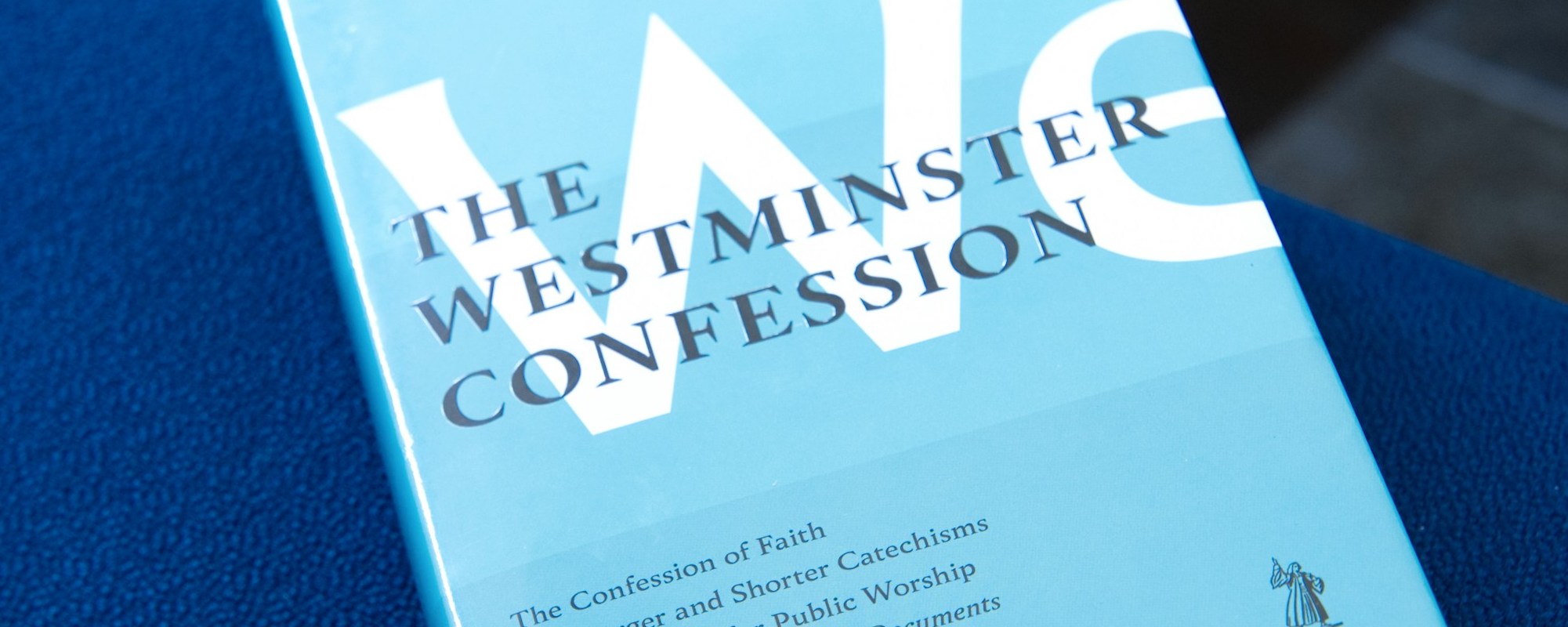
Pastor Jason Fest begins a series discussing Trinity’s doctrinal standard, the Westminster Confession of Faith.
Listen above or download the audio file here.
Transcript:
So today, and for maybe a portion, I’ll just give you a heads up, of next week, I’m not even really going to be delving into the confession itself per se, because there are some introductory remarks that I would like to make to set the stage. Some initial thoughts that I think are very important for us to consider and ponder as we approach the confession, the Westminster Confession of Faith. And I hope by doing that, setting the stage that way, we can really establish why it’s important.
Is it important? I mean, we have the Bible, why do we need this thing with all of these words in it? Good grief. That’s what I hope to challenge and get us to consider and think about. So I also have, I’m actually kind of excited about reading some alternative creeds and confessions to you to prove the point and drive it home, as we’ve mentioned before upstairs, that everybody’s got a creed and everybody’s got a confession of some sort.
Think of a confession simply as a longer creed. It’s got more in it, but it is simply a statement expressing what we believe or what the individual or the society believes. Think of the Humanist Manifesto.
I’m gonna be reading some excerpts from that. The Humanist Manifesto number one, I believe was written in 1939. What was that? It was an expression of beliefs about the world and the future and creating some kind of utopia that were expressed by a group of people, a society of people based on certain principles.
That’s what it was. It was a creed, even though if I’m not mistaken, I think in the first paragraph, they try to say this is not a creed. It absolutely is a creed.
And so I have some, I think, cool examples of alternative creeds to present to you as well. So this morning, let me start with some thoughts. I think I’ve read this before.
These are from Voddie Baucham. He was giving a talk, and I don’t think this was even the focus of the talk, but these were some remarks he made regarding confessionalism that I think are really important for us at the get-go, right out of the gate. And it’s this, that we live in a post-confessional age.
We live in a post-confessional age. We’ve moved into a post-confessional age out of an anti-confessional age. We’ve gone from anti to now post.
So here’s what he means by that. Let me look at my notes. Okay, so we live in a post-confessional age.
Now, there was a time when you could describe our culture as anti-confessional, and that was mainly for two reasons he gives. Number one is liberalism, and the other is what he calls experientialism. So liberalism recognized these confessions.
For example, the Westminster Confession of Faith, and they would look at it. They would know its contents. A liberal would say, yes, I see what you’ve written there, but we disagree.
A liberal, they don’t believe in the supernatural. They would take issue with the idea that you have to believe in the bodily resurrection of Jesus Christ, or the virgin birth, or creation, or the idea of the inerrancy of scriptures, of the scriptures. So they would take issue.
They would disagree with that. That is liberalism, and that was one stream during the anti-confessional age. The other was what he calls experientialism, and I think this is what we got a lot of around here.
This is still very pervasive, I believe, in our neck of the woods. Experientialism says we don’t necessarily disagree with anything the creed’s saying, actually, or the confession. We don’t really care, actually, what it’s saying.
We don’t want to put God in a box. That’s what experientialism would say. This thing you have here with all these words and these chapters that has been written, this is putting God in a box, and we don’t want to do that.
That’s what the experientialist would say. We don’t want to say what God can or cannot do. That’s how they would look at and approach these confessions.
This is based on the idea of continued revelation. In other words, we’re still waiting for God to give us more and more, and really what’s being inferred there, what’s implicit in that is that the scriptures, the 66 books of the Bible are not enough for the experientialist. You think experiential, think experience.
They’re looking for an experience with God, an encounter with God, the experience of hearing new revelation from him directly, and so everything in that system is geared that way to try to produce an environment to make that happen. That’s what it’s all about. So for them, this is like death.
Are you kidding me? This puts God in a box. It somehow limits him according to that way of thinking, and they don’t want that. So there’s two streams, liberalism and that, that experientialism that really were a part of what you call an anti-confessional, against this, against confessions.
Yeah, well, like I said, I think experientialism is still around, so I think there’s an element of it around, but let me get to post because I think that’s where you see something important. So I don’t know if it’s necessarily a strict timeframe. Certainly, you know, certainly perhaps the 1950s.
I mean, if you’re talking liberalism, you’re going to the very beginning of the 20th century there for that, end of the 19th, beginning of the 20th century for liberalism, but the rise of experientialism, I would go back to, you know, well, second great awakening, certainly the 1950s and 60s, the Jesus movement of the 60s, all of that. Now he goes on to say that we now though are in a post-confessional, post-confessional age, at least with liberalism and this experientialism, they acknowledged the confession and they knew what was in them by and large. They just didn’t agree with them.
Now we’re in an era where he says that most Christians don’t even know what a confession is. They don’t even know what a confession is. Is that, would you guys agree with that? Yeah, Heather shaking your head, yes.
I mean, try to explain to a Christian nowadays, let alone about the Westminster or the catechism, the Heidelberg catechism, the Westminster Shorter, you’d have to lay a whole lot of groundwork for even what a confession is, why we even have it. Where does it come from? Who reads these things? What bearing do they have on our lives now? Especially, again, we have the Bible. Why do we need these confessions and creeds and catechisms? There’d be a lot of work to do there.
And so I think Voddie’s right. I see his point. I think we do live in a post-confessional age.
Now, with that being said, I think we still have that stream, though, of experientialism, which is very rampant, too. But within that stream, he’s saying, they would know the confession and just disagree with it. I don’t know.
I would say in that experientialism, I don’t think they know what the confessions are. I don’t think they care. I think if you explained it to them, it would be like they’re choking to death and it would be awful.
So I think they aren’t really aware. I think that’s where you see, as I’ve said before, a large portion of the broader church has sort of redefined what church is, cut, severed, divorced itself from history and God’s providential workings in history, which this is an example. They’ve cut themselves off from that and are just living in the moment.
They’re looking for an experience. They’re looking for a new revelation. They don’t want to put God in a box, and that’s where they’re at.
Does that make sense to everybody? Any questions or any comments on that? Yes, Jill. I had never heard of consumption syndromes any time, I don’t know, maybe eight, 10 years ago. I said, well, people brought it up, and we talked briefly about it, and then it kind of moved on.
Yeah. So, you know, I’m not their age, and I don’t remember it. Yeah, when I underwent the change, whatever you want to call it, came into Calvinism through John Piper.
He’s a Calvinist, but he’s not confessional, so at that point, learning the doctrines of grace, wonderful, blowing up my mind, but nothing about confessions or catechisms or anything. I didn’t get introduced to that until I picked up R.C. Sproul, The Holiness of God, Chosen by God, and then a very excellent book I would recommend to anyone, What Is Reformed Theology? And that was the introduction to the confessions, and from there, it was off to the races. Talks about reform theology, its distinctives.
So as Vody said at the conclusion of what he was talking about, it’s fine that you come here or came here post-confessional, but just don’t leave that way. I agree. Just don’t leave that way.
We are, of course, we are Trinity Reformed Church. We are a confessional church. As I said in the email, we hold to, we point to the Westminster Confession of Faith as a foundational document, the confession that we would ascribe to.
That’s what makes us reformed. Or that’s what makes us confessional. We point to a confession.
If you’re a Baptist, something like Voddie Baucham, he would point to a confession as well, and his would be the 1689 London Baptist Confession. It’s a confession that they hold to and represents the doctrinal standards, the minimal doctrinal standards that the church holds to. Okay, so now some further thoughts on that.
Because we are a post-confessional, or live in a post-confessional culture, or are in a post-confessional age, thinking about us, myself included, I think that explains why, and you can tell me if you’ve experienced this as well, we forget that they’re out there. We forget the confession. We forget that the catechisms are very helpful, useful tools.
In evangelism, in terms of explaining the gospel to someone who’s never heard the gospel, in terms of a starting point there, like I think I’ve mentioned before, the Heidelberg Catechism, that opening question, you walk up to somebody, or you’re in a conversation and a door opens. What is your only comfort? Can you tell me what your only comfort in life and death is? What a great place to start. Then the more familiar you are with the catechism, the Heidelberg, it gives you a path where you wanna lead them.
If you’re discipling somebody who’s already a Christian, and they are, perhaps their faith is very, very shallow, a mile wide and an inch deep, and they’re looking for something deeper, we’re quick to point to podcasts and books. That’s a good one. What is Reformed Theology? That’s fine, there’s really good books out there, but how often do the confessions and the catechisms, the shorter catechism, how often do these resources that have providentially ended up in our laps, all the heavy lifting being done in the past, we have these things, these wonderful treasures, how often do those pop in our mind? If I’m answering, not often, not often.
I just don’t think about them. I’m not used to thinking about them. I’m not used to there even being an existence.
That’s my point. Now, recently, relatively recently, I’d say within the last year to a year and a half, talking with an individual, I did remember, I did remember from the outset, praise the Lord, and knowing this person, weighing the situation where they were at, I determined, and I had some choices, since this came to my mind, I elected to go the Heidelberg route, and that’s where I started with them. Got, you know, started asking those questions, got them to get a copy.
They’re dirt cheap. You can buy these things on Amazon. The Westminster’s shorter, larger, the Heidelberg, this little, I love this little edition of the confession.
Got like a little faux leather case or cover. You can get it for like six, seven bucks, 10 bucks online, and got them to get a copy, and we started going through it. Led to really deep, fruitful conversations.
Again, all with like a direction. It gave me confidence. I wasn’t leaving essential things out of our discussion.
It gave me confidence and direction to make sure I knew the point they needed to go, provided that pathway, it was a great tool. So I would recommend it. Yeah, John.
Did you let, just so we all know, the difference between a confession and a catechism? Yes, okay, right, good question. The difference between a confession and a catechism is the catechism is basically a confession written in a question and answer format. That’s it.
Catechisms are the confession, but written in a question and answer format. It asks a question and then provides the answer. And they are wonderful.
The wonderful thing I love most, I think, about the catechisms is they literally teach you how to think because the questions they ask, first of all, are incredibly profound, and they are the most important questions in all of life. And one question leads logically to the other. If you are depraved in your sins and destined or doomed to hell, what do you need? It’s kind of that kind of thing.
You need a redeemer. You need a mediator. It leads you to the next.
It gives you the answer that leads to the next question that you need to ask that you would not think to ask. So that’s what catechisms do. So apart from that format, they’re basically just a confession.
So yeah, we want to, and I hope a fruit of this series while Pastor Nate is gone on sabbatical, I hope to at least get us familiar, more familiar with these things, grow more familiar with them, starting with the Westminster Confession of Faith. And so that ultimately, they would factor into our thinking. Also, not only for discipleship, for sharing the gospel, but also for yourself, to grow yourself.
Again, these are tremendous resources. The work that’s been done already, especially in the Westminster when it comes to basic foundational doctrine of who God is, the scriptures, predestination and election, creation, all of those things. Well-written, concise, very easy to understand.
And all of the scriptural proofs always include. Yes. I’m sitting here wondering why some churches don’t really incorporate these.
Like for example, when I grew up PCUSA, that church, but we have these things in it, some of them. But then when I went away to college and started walking with the Lord and went to church, it was a, well, then eventually got into a Baptist church from a month, you’re actually. But.
We were trying to think, we may have considered it like extra biblical or something. Is that? I don’t know. But these things are not as hard.
Did you have it in the PCA church you said you started in? PCUSA. PCUSA. Oh.
But then when I started, I went to like this sort of Methodist church with charismatic leanings in college. It was alive for a Methodist church, it was spiritually alive. And then after moving to Florida, I started at a Baptist church because it was world missions focused and within driving distance, you know, pretty much for the criteria.
Sure. But they didn’t use any of those things. None of the Creed, none of the fashion, none of that.
And I’m just wondering why wouldn’t they? And I think it’s, I think maybe they considered it that way before. Or I don’t know. Yeah, I don’t think it’s any, I don’t think.
Yeah, I’ve, I study it because I’m just interested in it as a topic. But I would say with confidence, it’s not, I don’t think it’s any one thing. I think there’s a lot of strands that go into it.
I think one is what Voti is describing as this experientialism. So there you have a substitute. You have something else instead of that that’s put forward that’s pursued rather than that.
So that would be one. I think individualism is huge in our country, American individualism, I mean, right? I think that absolutely plays into sort of the disconnecting from the past sort of idea. And that falls in, that contributes to that sort of separating from these historic creeds and confessions and catechisms.
It just didn’t happen that way. I didn’t think they were aware of that. They were so caught up in sort of the way they knew things.
Yes. I don’t know. We certainly don’t value them.
Certainly do not value them. Absolutely. Yeah, Heather.
But I do know like the church that I was raised in, the sister guide, probably said we cut ourselves off from those creeds and confessions. We just studied the Bible. Yes.
That’s the Bible. Yeah. So.
Yeah, Steve, go ahead. To that point. So having in my discussions with different churches, different pastors, different things, I’m that guy that knuckled down over lunch and tried to throw down a jerk.
But the confessions are limiting and they are in opposition to a lot of modern theological standards. Therefore they are pushing themselves away and they cannot, they have to redline too much of it, right? So when you sit in a membership class at a modern Baptist church, typically what you’re gonna get is we don’t hold to this, we don’t hold to that, we don’t hold to this. But the basis is basically the 1689 modern Baptist or the Westminster is basically there, but we don’t hold to those things.
And it’s too difficult to hold that kind of theological position that is actually rooted in both history and in biblical standard, right? So we can’t be a modern church and hold to those things. So modern, modernism would also be a contributing factor. It’s all messed up, but it’s too limiting to have a standard on paper that we’re adhering to.
Yeah, that expression, put God in a box, I’ve heard a number of times. So it is a popular expression and way of saying no, where that came from. And also to Heather’s point, I’ll get to you in a second, Ben.
To Heather’s point, yeah, several years ago, checked out church websites, their denomination. I think it is Church of God, is that the denomination of which you have first? I don’t know, I don’t know how it goes, but yes, they intentionally explicitly said, we do not believe in these confessions. We distance ourselves from them.
That’s in their confession. Cause it was a confession. Yeah, Ben.
Thank you for no agreement price. Yeah. And to your point about individualism, I think for me, what I’ve heard, that these people talk about, it’s like, oh, you’re replacing the Bible with a confession, you should do that.
Like this come down to a summary of what the Bible is saying. Right. But to your point about individualism, I think we don’t want, they say, we don’t want to put God in a box, but what they’re really meaning is, I don’t want to be put in a box and be held to these confessionalists and what the Bible actually says.
Yeah. We would rather just like involve ourselves in like therapeutic sentimentalism so that we can be supernautic and hyper-spiritual. Yeah.
Yeah. That’s a good point, Ben. I agree.
They don’t want to be put in a box. And that goes right along again with Voti’s remarks about this experientialism. I’m always hungry for more.
Scripture’s not sufficient. And I want a direct experience with God. This limits who I can imagine God to be.
Yeah, Mary. I think also there is a segment of the church that does not want to look Catholic by any means. And the catechism is often associated with Catholic church.
I grew up Catholic. It was all about the catechism. Yeah.
Not that we learned it. Right, right. But we think about it.
This one. No, not this one. Yeah.
But so I think that’s also part of things that people want to go so far. And they’re like, I don’t want to look Catholic. And that just sounds Catholic.
So I don’t want any part of it. Yeah, that’s a good point. I hadn’t thought of that.
You’re right though. So there is the confessions, the creeds, the catechisms sort of come with baggage. A lot of people hear that term, that word, they are immediately associated with Roman Catholic, and they don’t want anything to do with anything even remotely associated with that.
Yes. Church growing up, even though they gave us new creeds and confessions, and told us they were too rigid for seeker-friendly services or friendly programs. I mean, that was the case.
They wanted to be an open space where anybody could come in, feel comfortable. And we didn’t want to put rigid lines on gates for people to come in and feel comfortable and welcome. And I think the experiential thing, I know I have said before, God is bigger than that.
My God is bigger than yoga. I can do yoga because my God is more powerful than yoga. So even though I’m doing it, He’s not controlled by that.
He’s not scared of it. So He’s big. That experiential, if anybody would have told me about a creed or a confession, I know my response then would have been, my God’s bigger than a creed or a confession.
Why do we do that to define Him? We’re gonna define my God. He’s bigger than that. He’s got a universe.
I know I’ve even said that in the past. Yeah, yep. Yeah, I’d say that’s a popular sentiment.
So yeah, a big challenge there in terms of who you would be talking to. Because again, going back to my first point, if you would turn to the catechism to help as an outreach tool or a discipleship tool, which again, it is so, so good at. I mean, when you think historically the church, if you put it on a timeline, at least going back to the Reformation, catechisms by the way, and confessions come from the Protestant side, not the Roman Catholic.
If I’m not mistaken, it was the Roman Catholics who developed their own in response to what the Protestants were doing. That’s ironic that that’s what happened there. But to use them as tools, you’re gonna have to overcome these hurdles with people.
And so this is good. This interaction we’re having as we think about this stuff, because you got to think about how you would broach the topic with somebody or introduce this. This is the kind of pushback you’re gonna get.
And you need to think about how you would get around that. Yes, Jill. With these, it’s marked by scripture, isn’t it? Like when you read parts of the catechism, you can go back to the scripture and support exactly what they’re talking about.
So in a way, if people are saying it puts you in a box, then, well, I guess some people think that the Bible puts them in a box. My bet would be, and here’s my hypothesis, that those who say this puts God in a box have never even bothered to read it and couldn’t even find it. That’s my guess.
I don’t think they’re saying this puts God in a box after reading through it and understanding what it’s communicating. Because you’re right, the first thing you would notice is that every sentence has that little alphabetic letter pointing to scriptural proofs that support why they’re saying that. It’s all, the confession is built on the theology of the Bible and scripture.
Yes, Kathy first. So a few years ago, some friends came and we did, you know, we say the confetti together. Well, it became, I don’t care for that because that’s cultish.
That’s very cultish. When you have a group of people repeating everything every week, the same thing. So I know that’s the other thing that together we do for people.
Sure, right. Well, but they don’t understand what it is either. Right, and while they’re missing the framework, they’re missing the framework and the context of, right.
No, no, same. That’s a good point. Yeah, this is not cultish.
Who else? Yes, go ahead. Following the kind of thought and kind of processing that thought about, it seems like evangelicalism moved away from traditional mainline and wanted to be more from the heart. And they saw these prayers and these greets as sort of like from the head.
And so they kind of just cut it off altogether because they misunderstood it or misapplied it. Because these things are wonderful, rails to run up from the heart. When we pray these things, the greets and things and say these from the heart, not just from the head, they’re rich.
Yeah, when we get to chapter two on God, I hope to impress upon you that, boy, you could read that as a prayer and I do pray it. Not often as I would like, but when I do. I mean, you talk about reading a concise statement that takes the whole counsel of God and puts together this singular paragraph on who God is.
And you incorporate that into your prayer life. I mean, you talk about something that gets your focus off yourself and your problems, which are, when we’re focused on ourself, our problems become giant mountains. You talk about something that shrinks them down to molehills and gives you right perspective.
That’s right there. And so again, you think of the work that went into that, the crafting of that statement. 1646 through, I can’t remember when, these guys coming together, these divines, these pastors and laymen over and over again, just pouring over this stuff to produce this document, doing all that hard work.
And here we just have it. We can benefit from it. So first, what I want to do, hopefully, is begin to make us more familiar that it exists, more familiar to the point that we begin incorporating it into our own devotional life, and also begin to think of it and see it as a very valuable tool in our outreach to other Christians or non-Christians as a gospel, a way to share the gospel or as a way to disciple.
John? Yes, that’s a good point about kind of wanting not to thrive, bringing, you know, just like the data, the theology of data points, and that’s all it is. But it’s like, so you do want to preach or teach to the heart, yes, but you have two voices. If you go through the ears and brain to the heart, or you try to bypass the brain to the heart, now you say like, oh, well, what do you want to do, right? You want to use the brain because the ear is here, and then the heart and will can be activated, to use, I’m sorry, it’s too corporate sounding, but then can go into action in obedience to the word coming into the brain.
But it’s got to start there, it’s got to start with the mind. And if you don’t, well, then that explains it’s all this experientialism, like, well, why a fog machine? I mean, seriously, why a fog machine? Well, it’s because there’s something emotive about that. And when the lights come down, and when the music starts at the end of the sermon, you’re trying to evoke something by bypassing the brain.
And what’s great about these catechism is like, no, no, no, that is not how God operates in the world. He operates through the word first. Other things support it, but the word has to be central.
Yeah, that’s good, that’s a good point. Yeah, Jordan. One interesting thing about the fog machine kind of people is that they are kicking back so hard against Catholicism.
If they saw like incense and smoke going up in church, they would say, oh, no, that’s horrifying. But then they have their own incense and a fog coming up in church. And somehow they’ll be exactly like each other.
I think that’s actually a great misconception, the only group that is pushing any resistance to the Catholic church would be the reformed body. The greater Christianity accepts Catholics as one of their own, that even all the way back to the Promise Keepers Movement, that was in conjunction with the Catholic Church International. So for the last 40 years, evangelicalism is arm and arm with Catholicism.
True. So it’s only this small subset that is actually in conjunction to the church as established. Yeah, that’s a great point, Steve.
I think it was the ecumenical movement. Sure. Ecumenicalism, let’s, we have to, we have to come together, we have to join arms.
I think big Billy Graham would have been a big proponent of that. So again, we’re going back to the 1950s. The motivation isn’t anti-Catholic at all.
Yeah, I agree. It’s basically, how do I have my cake and eat it too without doing the hard things? Yes, yes. Now, with the time remaining, let’s point the finger at ourselves before we go today and discuss, okay, what errors occur on our side of the ledger? We’re pointing the finger, we’re not really pointing the finger.
I mean, we really are, we’re looking at the field, we’re looking at the broader church and where it leans, its history, and why it does what it does, because for many of us, we’ve come out of that, we’ve been brought out of that, praise the Lord. We see its errors more clearly, but what are the errors in the Reformed camp? Let me give you one. One significant error, I would say, in our camp is a trust in doctrine too much to where if you know the doctrine of total depravity, it’s almost equated as genuine faith in Christ, but you’re lacking the relationship, but your confidence and assurance is coming from the fact that you know the doctrine so well.
That’s a big temptation. How do you know you’re saved? How do you know you possess saving faith? Well, I know the five, I can recite TULIP, I know the doctrines of grace, I can explain to you with scriptural proofs the doctrine of total depravity. No, I know these things, I’m good, I’m good, I’m saved.
So we have to be very careful to make a very important distinction there. You need to know these things because you can’t believe in something you don’t know or understand, so knowledge is important, but knowledge does not save. Jesus Christ saves, and all of these things, the Westminster Confession of Faith included, are meant to drive us to give us the right information, the truth, because it comes from God’s word, to point us to Christ, but we still need from God the capacity to receive and believe all of this and thus be saved.
To believe in, to know, to have a relationship with the true, the real Jesus Christ whom God sent into the world. There has to be that relationship, so that goes beyond mere words, but again, we also need the words, we need the understanding so that we’re not ultimately following an idol, a God we’ve created in our own imagination. How do you know you haven’t done that? How do you know you’re worshiping and praying to and trusting in the real Jesus and not another Jesus, as Paul says in Corinthians? Well, you need to know the truth.
You need accurate information that comes from the living and active word of God. That’s what you need. So it’s both, that’s what we’re gonna get into in a little bit in the coming weeks.
You need accurate information, you need the truth presented to you, but then you also need the capacity that comes from God to receive that truth savingly. All right, any other questions or comments? I think that’s probably a good place to, I don’t wanna start on something new at this point. Okay, let me say this.
If you haven’t already, please consider, I would very much encourage you to get a copy of the Westminster Confession of Faith since that’s where we’re gonna be going through. Like I said, you get on Amazon, you can find a copy. Let’s see, what do I got here? I carry around with me.
I got a nice little pocket edition of the Heidelberg, this great little pocket edition of the Westminster Shorter Catechism, great little pocket edition of the Confession of Faith. They have some with large prints that are bigger. Eli has one with ESV scripture footnotes.
Most of them are King James. Go on Amazon and you can get it for like six, seven, 10 bucks the most. I don’t know, this might’ve been $17.
I paid a little extra, I love it. So please do that because that’s what we’re gonna be going over. And again, that’s part of all of us becoming more familiar with these things, keeping them, being aware of them and having them with us, okay? All right, if there’s no other questions, dismissed.
Photo by Skyler Gerald on Unsplash